Ghosts in the Machine: Generative Interfaces
Following my introduction, this essay examines generative interfaces as an object of study where bridging "techie" and "fuzzy" creates the potential for fundamental breakthroughs.
Early Apparitions
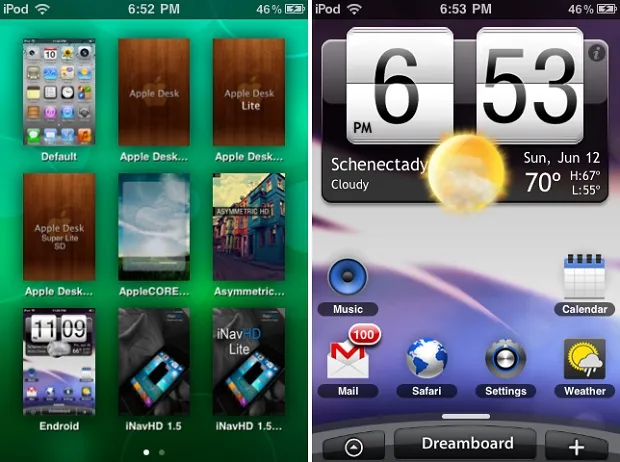
I've long been fascinated by interfaces, from jailbreaking my iPod Touch for DreamBoard to spending time in the Virtual Human Interaction Lab at Stanford.
Naturally, I was excited when I heard about generative interfaces as an emergent capability unlocked by LLMs. My "inner techie" marveled at how engineering paradigms (e.g., frontend/backend) change when interfaces don't just route information but reason about it. My "inner fuzzy" was struck by Andrej Karpathy's recent suggestion that LLM research is about "summoning ghosts"—a phrase that recalled (my favorite philosopher) Jacques Derrida's ghost-themed theory of hauntology.
The arc of innovation tends to be punctuated by eureka moments borne at the intersection of technical breakthroughs and insights about the human experience. We've seen this once before in interfaces—Jobs's conceptualization of the computer as a "bicycle for the mind" was more a philosophy than a spec.
I believe generative interfaces have potential to be the next breakthrough. What makes them so resonant is how they let users live in time the way humans actually experience it: as a web of hauntings, not a sequence of present moments.
Tracing Ghosts
I define generative interfaces as systems where an LLM reasons about what data to surface and how to render it. More formally, the LLM can be thought of as operating over a joint search space across existing data (retrieval) and UI primitives (modals, chat bubbles, calendar invites)1. In practice, this framework captures a diverse array of emerging products, such as new operating systems, personal AIs, and ambient computing devices.
Whatever the form, generative interfaces aim for a deeper and more qualitative understanding of the user. One approach, implemented by companies like Tomo, might involve an initial conversation about what matters most to the user, seeking to help them build habits (e.g., exercise) through the lens of goals and values rather than logs and metrics. Another, leveraged by companies like Telepath, deploys parallel agents that process ingested unstructured data to perform "sensemaking" about the user. What topics are they interested in today? What are their present priorities? These generative interfaces improve their understanding of the user over time, which in turn improves responses.
Another defining quality of generative interfaces is their stochastic rendering logic. Traditional systems route data through pre-defined templates: here's your inbox, here's your calendar. In contrast, generative interfaces navigate the joint search space described above. Consequently, the same memory might appear as a calendar notification, a conversational prompt, or a reprioritized task list: the interface refuses to stabilize. Imagine a diary entry you wrote years ago surfacing alongside today's news, or a fitness goal you texted last month reappearing as a motivational nudge. It is this stochastic nature of generative interfaces that creates emergent, additive potential to how we experience technology.
Summoning—and Speaking to—Ghosts
Jacques Derrida's theory of hauntology argues that Western philosophy has been built on the "metaphysics of presence"—the assumption that "being" means fully present, complete in itself. Hauntology is the counter-concept: the present is never simply present; it's always haunted by traces2 of what came before and what's yet to come3. Traditional apps embody a metaphysics of presence. They show you what is (your current inbox, your current to-do list). They archive the past (sent emails, completed tasks) and make it inert—no longer relevant except as historical record.
Generative interfaces resist this by being constitutively haunted. They pull forward what was said, thought, or intended days ago and let it interrupt the present. The past isn't completed; it's ongoing, continually reshaping what matters now.
To extend Karpathy's metaphor: if LLMs are "summoning ghosts," generative interfaces are the medium through which these ghosts speak to us about ourselves.
I believe generative interfaces succeed precisely by honoring Derrida's insight. Surfacing what matters isn't just efficient—it's truer to how we actually experience time. We don't live in a sequence of discrete present moments but rather a field of hauntings: yesterday's conversation shapes today's decisions, next week's deadline reorganizes this afternoon's priorities, last month's insight suddenly becomes relevant again.
Remarkably, the technical foundations of LLMs seem to align well with the philosophical foundations of hauntology. For example, the attention mechanism, in being computed across all tokens, can be thought of as the trace. Because each successive token is generated through the attention mechanism, its presence is then "spectralized by the trace," i.e., constituted by the presence and absence of all training data and prior context.
As one point of praxis: take Tomo, whose interaction patterns suggest that their users prefer texting about weightlifting goals with a personal AI rather than logging them in a generic fitness app. How could this be? The conversational medium keeps the past alive rather than archived. The app says "here's what you logged" (presence, completion, archive). The thread says "here's what we were working on" (haunting, continuation, living past). Users choose the thread because it matches their actual temporal experience—goals aren't achieved and filed away; they persist, evolve, haunt until they're genuinely resolved.
Closing Remnants
As generative interfaces develop as a research area, much will be said about the technical challenges involved. But it's also worth examining why they deliver novel, delightful product experiences in all myriad forms. Generative interfaces will succeed because they honor the human truth that we are haunted subjects, living not in the present but in the traces of what was and what's yet to come.
Special thanks to Chelsea, Emily, Justin, and Sid for their feedback and for pushing my thinking.
Footnotes
It is exciting that the UI primitives themselves may eventually be generated by the model. The complexities of getting this right make generative interfaces a substantive research area↩
Ironically, Derrida invoked the word traces as a term of art (la trace), much like there has been much fanfare about (decision) traces as critical ingredients to context graphs↩
As equivalently-and-perhaps-more-straightforwardly expressed by Taylor Swift in "Haunted": "something keeps me holding onto nothing"↩